Jessica

More On Compound Words

Now remember, just because my title says “compound words,” doesn’t mean that your little one will know what a compound word is.  We are just teaching our children the content at this point….not the vocabulary.  We are teaching them age-appropriate oral language skills.

So, that being said, today we are going to give our children more practice playing with words because if you have read some of my other reading posts you know that “playing with words” and other listening activities will help your little one become more and more skilled in hearing and distinguishing that words are made up of sounds.

Today I want you to print the document I have made, cut out the pictures, and first READ all the names of the pictures to your child a few times.  Then see if they can tell you the names of the pictures.  This is an oral language warm-up.

Now, I want you to show your little one that if you put two pictures together it might make a new word, but that word can be a real word or a silly word.  Give them examples and tell them why because you have to model the activity before you ask them to try.

Let your child determine if the new word is real or silly, but be there to support their thinking for the answer -right or wrong.  Meaning, praise them if they are right, but if they are wrong always preface your correction with “No, but that was good thinking or a good try.”

You will write their answers on the real/silly recording sheet to model writing the new words 🙂

Picture Combo

Games Galore

When I taught kindergarten I had a lot of ABC games that I could use in whole group and small group settings to practice the content I was teaching my kiddos.

I felt as though it was time for me to give more ideas for teaching ABC and letter-sound correspondence to anyone in need of ideas.  There is a difference between teaching letter identification and letter-sound correspondence (knowing the sound that a letter represents).  But, it is important to teach both of these skills parallel to each other, to take your time teaching these skills, and to re-teach often. Continue to expose your children to letter names and letter-sound correspondence, but if your child is just learning letters, don’t overload them with the sounds just yet, be intentional to teach the letter names and the letter formation. Below are some examples of some of my favorite games for these skills.  You DO NOT have to buy all of them for your child to learn these skills.  Consider buying one of each OR recreating your own version of one of them at home.   Take a picture and send it to me if you come up with a homemade game that I can share 🙂 

All of these games are more beneficial to the learner if it is played with YOU because children learn best when someone is there to build on their current understandings.

Patterns Round 4

I hope you aren’t sick of patterns yet…especially since this is all so new to your little one.  There will be subjects you are passionate about teaching, and hey, who knows, maybe patterns is one of them.  Not quite? Well, you cant say I didn’t try to persuade you.

Your child is going to continue with making any pattern of choice, but today you will encourage your little one to extend patterns after following an example, and make pattern arrangements without connecting the cubes.

I made pattern cards that I want you to print onto cardstock (for sturdiness) and cut out in strips. 

Then you are going to 1) show your little one how to copy and extend each pattern and 2) include your child as you extend the pattern (“hmmm…I wonder which would come next?”) 3) allow your little one to copy and extend them on their own.

Pattern Cards

Blank Pattern Cards

I attached a blank pattern card document in case you don’t have the colors I used OR you want to give them more to practice with in which case you can color your own 🙂

After your little one is building confidence, encourage him/her to make patterns with the cubes without attaching them together such as one facing up and the next flipped facing down.  Additionally, allow them to explore patterns using household items or toys your child has such car sizes: big, small, big, small, etc.

This extension of the pattern concept will prepare children for seeing patterns extended in designs and later on, in numbers.

Support For Home Schoolers

I received an e-mail from a Mommy Teacher User who was asking for ideas to ease the home school process.  When I tried to respond there was an error with her e-mail address; so, I decided to share my thoughts with all of the Mommy (and Daddy) Teachers out there.

On the “Getting Started” page of my website, each subject matter follows a sequence of children’s development.  Each activity has ideas on how to make learning FUN for kids.  But one thing that I noticed makes learning easier is when you include another child (or more) because children become more engaged with social influence.  Activities become more like games with their peers, and adding the social development factor is KEY for home schooled children anyhow.  Pair up with another homeschooling mom (two, or three!) and take turns teaching activities… if that is an option. 

I have A LOT of ideas…I’d love to share more if you can send me some additional info, for example: What types of activities and content have you been working on with your child so far (ABC’s, Numbers, etc.)?  How much time do you spend on each activity?  Do you follow a curriculum?  Is she the only child you home school?

Let me know any other ways that I can help!

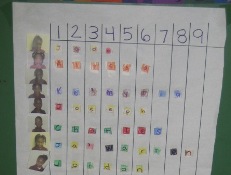
Make A Name Chart

A lot of children want to know how to write someone’s name. They go around with a pen and paper and ask you how to spell whatever they want to write at the moment. Instead of telling them the letter, give them clues instead: the first letter makes the sound /b/, it is the second letter in the alphabet, it comes after the letter “A”, it starts with the same sound as ball, etc. 

Another way you can help them is to have them reference a Name Chart.  In my classroom, I used to make a Name Chart so that the children could compare the length of their names, the letters in their names, etc.  I would let them write each letter of their name, cut it our, and past it in letter order on the chart.  The children loved to use this to help them write their friend’s names when they drew a picture of their friend. 

But this can also be done in your house as a writing prompt.  Make it as a family and post it in the playroom or your child’s bedroom. 

1. Instead of buying and using a posterboard to display the names and faces just make a word document!

2. Insert a table if you would like to have the “numbers” row; don’t if you dont care for the way it looks.

3.  Insert a picture from a file and crop it until it shows only one face of a family member, friend, or pet.

4.  Ask your child help you find the letters on the keyboard as you type the names beside each picture.

5.  Print it, post it and voila (“there you have it”) a complete work of chART 🙂

Related Posts Plugin for WordPress, Blogger...

1 61 62 63 64 65 72