
Jessica

Introducing the Concept of Pattern

Don’t write me off too soon! I have talked to a lot of moms of my kindergarten students who practically want to punch me in the face if I spend too long on this subject of patterns.  They say “My child worked on patterns in Pre-K, and he (or she) picked up on it very quickly.”

Trust me, I understand, I teach the subject over and over again so I can also get a little burnt out on patterns myself, but as a teacher let me talk to you for a moment about patterns so you hopefully won’t roll your eyes with each pattern post.

When your little one learns about patterns he/she gets so excited and thrilled to practice this skill because it gives order and predictability to activities, and how things in life work together in general.  After the concept of pattern is developed, children can predict that Tuesday comes after Monday, lunch comes after breakfast, and eventually they will learn that the number system is based on a pattern understanding that 12 comes after 11 because the tens place stays the same and the ones place follows a pattern of 1, 2, 3, etc.

So, the whole AB, AABB, ABC pattern lesson is a means to understanding the bigger picture of observing patterns in everyday life.

If your child understands certain aspects of patterns….GREAT….build on that.  There is usually an aspect of patterns that can be taught to add to one learned.

First, patterns can be taught in rhythmic motion such as listening to a beat and predicting what might come next.  Then, patterns are taught using color, shape, and arrangement.  Then, patterns can incorporate a letter symbol.  Then, patterns can be taught by extending all those skills with a higher level of difficulty.  Then, patterns can be taught using numbers.  Additionally, with these understandings, patterns can be observed naturally through everyday occurrences such as waking and sleeping, days of the week, seasons of the year, etc..

The main lesson in teaching patterns is that something repeats itself.  So remember the “I do, We do, You do” teaching skill from the post “Math on my Fingers” today you are going to:

1) Start a pattern to a beat such as “Clap, pat (your legs), clap, pat, clap, pat……
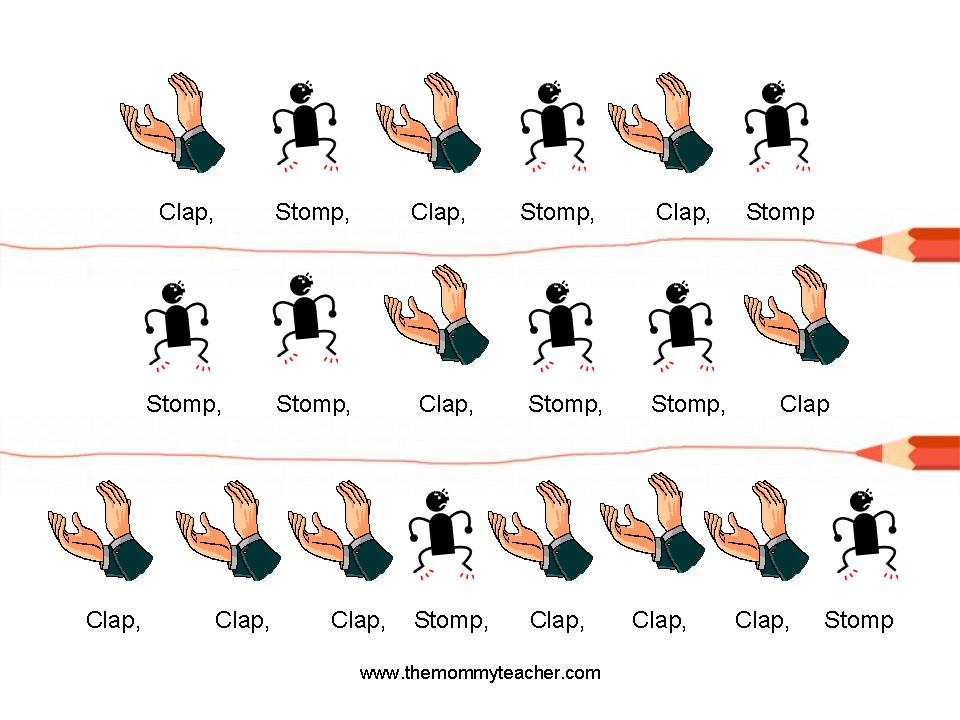
Rhythm Pattern

2) Ask your child to join in; continue on for a minute or so.  Then you are going to add the words saying “Clap, Pat, Clap, pat….”

3) “Let’s do another pattern using our bodies” Ideas: stomp, tap your head, snap, nod, tap your shoulders, flap your arms, etc.

4) Ask your child if they would like to come up with one for you or a family member to do. If your child does not follow a pattern, remind them that you want to pick one of two things that repeat themselves over and over again like the one you chose.

5) Practice variations of this over the next few days in my next math post I am going to add an extension activity for this same rhythmic pattern activity.

Consider purchase the following cubes, book (or a similar book) for the next few pattern lessons:

Write a Survey

Teaching Kindergarten was such a great learning experience.  I have so many flashbacks of memories that remind me how much children enjoy the simple things.  One simple thing my Kindergarteners loved to do was go around the room and take a survey of information; their favorite survey seemed to be likes and dislikes.

Pick something that your little one might want to find out or ask your little one what they want to ask.  Brainstorm with them….”Do you want to find out how many people like Fireworks?  Or how many people like sparklers?  Or how many people like party hats?” 

1. Click on the following like, and print out the sheet (or make one like it if you dont have a printer).  Like/Dislike Chart

2. Pick one topic and model writing it into a question at the top of the page in the space provided.

3. Place the page on a clipboard.  My kids loved this because it made them feel so professional. Here are some fun ones I found on amazon:

4. Have them go around the room and survey family members, friends, or even stuffed animals or dolls pretending that they are responding. 

5.  Allow them to record this info ANYWAY they choose: checkmarks, x’s, a Y for “yes” and an N for “No”, etc.

Do the first one with them 🙂 

This is a great way to teach organization skills because it is formatted as a chart, and it can even incorporate counting skills and more or less if afterwards you help them add up to see whether or not the majority of people liked or disliked the given topic. 

As always, have fun!

Selective Book Search

Books are a GREAT way to INTRODUCE new concepts.  If I am teaching about shapes, focusing on squares, I might pick a book from my expansive library that centers around squares.  But~ I would make sure that I discuss the pre-conceived understandings about squares first.  I might ask the little one “What do you know about shapes?” This one question “What do you know?” is probably on the first column of a 3 column KWL chart of classrooms all across the country.  The K stands for “Know” -what do you already know? The W stands for “Want” -what do you want to learn? and the L stands for “Learned” – what you have learned after the subject is taught.  So a great way to plan your teaching is to first learn what your “student” already knows about the topic.

Then, I might make some associations – brainstorming with the little one about what squares remind them of.

THEN…I would read a book about it 🙂  – but this is a great time to bring in visuals, dig a little deeper into the topic, and ask questions throughout the reading that get them thinking.

Afterwards, I could do an extension activity with them to “extend” their understandings, or have them record (draw) what they have learned about shapes from our discussion and book.

And quite honestly, as a teacher, I learned a lot from books; not just growing up reading books.  I learned a lot from reading books to my Kindergarteners.  In fact, I love kids books and grew an appreciation for them, but I still find it important to select books strategically.  You need a good balance of fiction and non-fiction.  You need to select a variety for each topic.  And you need to make sure the book is engaging.

There is a difference between read-aloud books that carry a life lesson, and books that teach a specific subject matter.  I have tons of favorite read-aloud books, and a lot of favorite books on each theme I am teaching.  Buying them can be great to have your own little library, or you can check your local library for availability.

Either way, I am going to make an amazon list of books for you to check out.    Feel free to E-MAIL ME if you have any questions about searching for specific resources.

So, if you haven’t figured it out already…today’s activity is to READ with purpose whether it be on colors, shapes, counting, alphabet principles, etc. 🙂

Guess How Many Are Left?

Before I talk about today’s activity, I want to bring some insight to the table so that you will know even more about your child’s development.  If you read the math page of daily funwork, you will learn that today’s activity meets the needs of the earliest skills to practice….counting objects.  So that is why today’s activity will not incorporate number symbols.

1. Find a clean sock, mitten, or something that you cannot see through.

2.  Count out a group of 5 counters such as marbles, blocks, coins, etc. 

Order some counters for future activities (if you don’t have any counters you can use):

3.  Count out the manipulatives you selected with your child.

4.  Invite your child to play a guessing game where you will place the “marbles” in the sock and then take some of them out.  You will show them how many you took out and ask them to guess how many are left.  If your child guesses higher than the number, ask questions such as “Do you think there are more than 5 or less than 5 left now that I took some out?” to get them to use critical thinking.  Let your little one feel the sock to try to figure out the amount left.  Take them out and count to check how many are left after each turn.

*If your child is not yet ready for this skill, if they are not guessing anywhere near the correct number after many times of practice, it is OKAY, use it as a counting practice activity 🙂

Writing Readiness

If you have determined that your child may not yet be ready for writing activities, then I want you to allow your little one to have a lot of practice simply doodling or coloring to gain control, coordination, and strength in their hands to write.

Playing with playdough and various other fine motor skill activities will get your little ones READY to write by developing the necessary motor skills.

I have my little two year old make likes and circles on paper when he is coloring and writing but he likes to attempt to trace so I made this:

A VERY basic activity for pre-writers who are not yet ready for tracing defined shapes and figures.

Pre-Writing Template

Related Posts Plugin for WordPress, Blogger...

1 64 65 66 67 68 72