Let’s do some more letter activities because the alphabet is a great way to introduce concepts of print in a systematic way.
Being able to read the alphabet aloud with a pointer, pointing to the correct letter and not zooming ahead or falling behind is a great milestone that represents your child’s understanding that print communicates something.
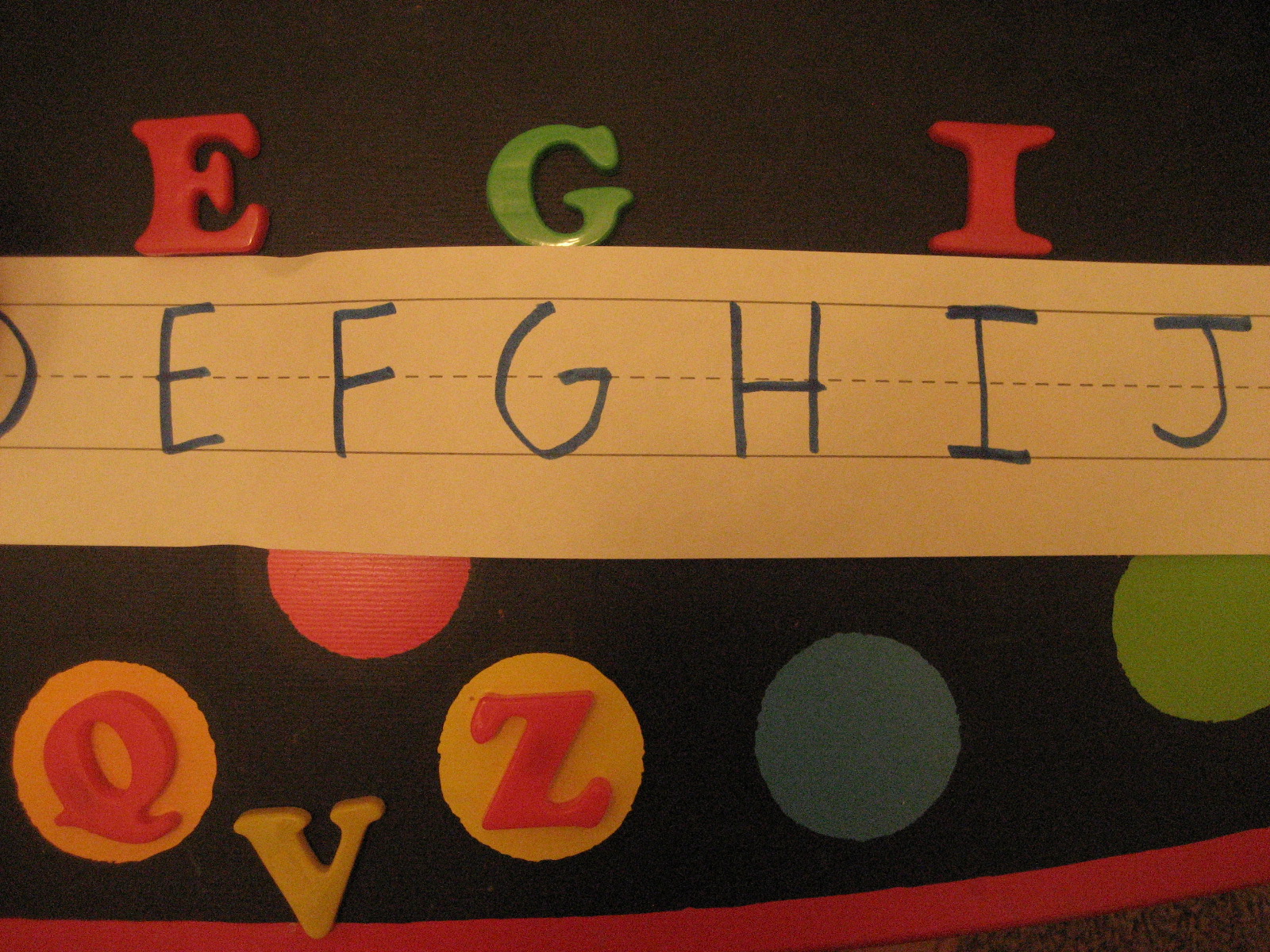
First, write out the alphabet in large letters / use the alphabet sentence strip poster you made for the post “Read the Playroom.” Lay it out on the floor.
Then, I want you to search around your house and find some alphabet pieces that your child can manipulate –like the foam ABC set for the bath, or the magnetic set you can buy at the dollar store, or puzzle pieces, whatever you have. And I want you to lay them all out on the floor in no particular order. Then I want you to tell your child that you want to put them in the order that we read them when we sing the ABC’s. In order to do this you are going to match the manipulative letter to the written letter. Each time you pick a letter….talk about it. Do you know this letter? Where is its place in the alphabet, the beginning, middle, or end? What letter does it come after/before?
If your child isn’t sure…sing the ABC song until you get to that letter; your little one will most likely act super excited that he/she “found it.”
If you want to accommodate to make the matching skill more difficult….draw the lower case of the alphabet and match the upper case to it.
introduce a number set 5-10 Math Stories
In order for your child to learn math skills you will need to incorporate A LOT of hands-on practice and be ready to “play” hands-on games over and over again. The goal is to master 1) hands-on concepts (such as counting blocks) before moving onto 2) symbolic (counting pictures on a paper) and then 3) abstract (visualizing “three” when looking at 3 objects). I can’t even begin to tell you how much research has been conducted on these 3 steps to introducing a new skill to children. So, don’t get ahead of yourself trying to keep up with the Little Einstein’s.
So today’s activity is another hands-on activity for you to begin to introduce a number set of 5-10, in parts. This is an age-old game that I play with my friend’s kids making sure to ask them a lot of deductive reasoning questions while playing with them.
Here it is:
Math Story Activity
And here is a “work mat” if you want to just print one out….they are easy to make. Make your page orientation landscape and insert clip art and blow up. You could always print it onto cardstock and place it in a sheet protector so it will last longer 🙂
Park Work Mat
Write a Letter
There are so many different ways you can write with purpose: lists (grocery list, wish list, checklist, etc.), postcards and letters, journals, menus, signs (traffic, household, labels), and many more.
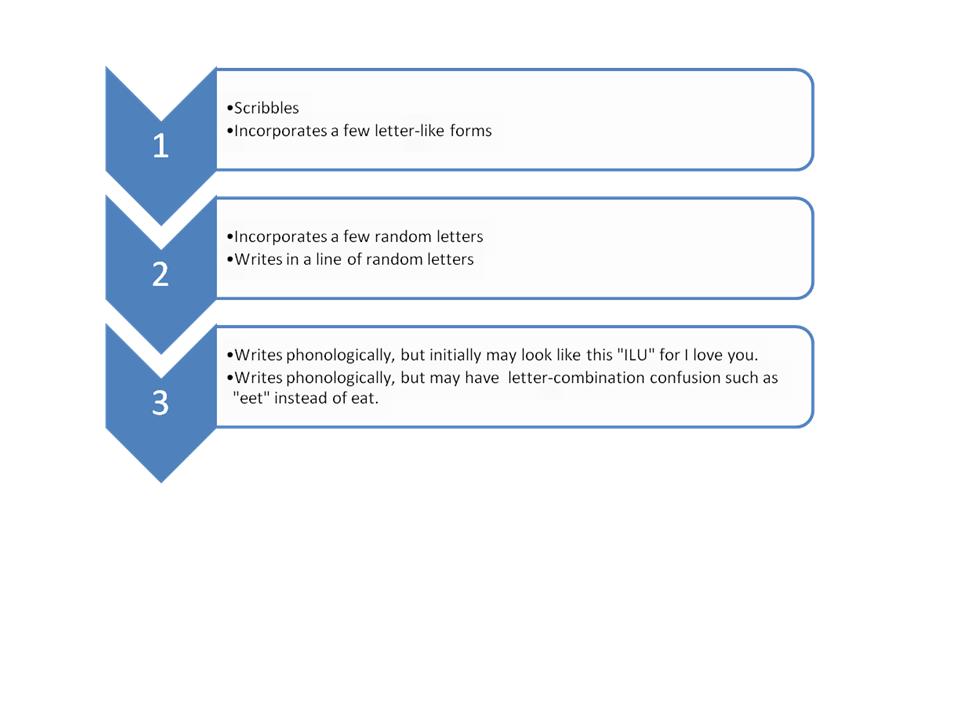
After years of exposure to all these different written language, adults written form looks clear and organized whereas a beginner’s written understandings may look like zigzags, horizontal lines, and swirls because they view writing in a linear way, and I am writing about this today so you understand that that is OKAY….it is all part of the process. Children’s writing process looks like this:
Children have to experiment with writing in many ways before they start to learn what it is all about. So, today I want you to let your child write a letter on the template provided. Don’t pay attention to any details (letters fitting on the lines, or really letters in general). Let them scribble out the letter if they want. You can keep a notepad next to you and write down everything they said afterwards, but for now let them get carried away! You can learn a lot about what your child does understand from just listening and watching. Does your child make letter-like forms? Does your child try to incorporate letters? Does your child try to sound out words? But do try to observe how your child holds their pencil and what hand they are writing with. They should hold their pencil with their thumb and middle finger, with top-support from the pointer, and bottom-support from the ring-finger.
Letter Template
Have fun!
fluency is key on literacy Read the Playroom
One thing that I have in my playroom at home is a poster of the alphabet in two places on the wall. This may seem like a teacher-thing to do, but I recommend posting an alphabet on your child’s eye level.
Fluency is KEY in literacy throughout every stage of proficiency. When children “read” things, it means that they realize print carries a meaning. So if you pass the Burger King sign and your child says “I know what that says….it says Burgers” you can encourage them that they are so smart and they are learning to read words. All of their understandings, like the example given, are preceding their literacy foundations.
Today’s activity is one that will hopefully be posted on the wall, right in your little one’s view, to read and practice as often as they choose to do so.
Materials you will need (you may need to shop/order online; each of these are on my homepage under “fav. things”):
-sentence strips (these are long strips of cardstock material…but you can also cut a posterboard into strips)
-marvelous tape (tape that doesn’t peel off paint when you put it on your wall)
-pointer (a cutesy one online or even a fly swatter lying around your house)
Activity:
Write the Alphabet twice (one set uppercase, another set lowercase) onto sentence strips in a pen. Let your little one trace over the letters using a highlighter. Tape them at eye level in your little one’s bedroom or playroom. Encourage your little one to use a pointer of some kind to “read the room.”
Each day you think of something new, or your child reads something (like the word Cheerios on the box) add one new thing to read around the room. Cut out “environmental print” such as the Cheerios box top, the fruit by the foot box cover, etc. and post them in the playroom at eye level. Have a blast!
Geometry Starts Here
There are actually a lot of elements to teaching and learning shapes because there are a variety of 2-dimensional shapes and 3-dimensional shapes that are distinguished by lines, angles, bases, sides, etc. And believe it or not, 2 and 3-dimesional shapes are introduced in Kindergarten, as well as tangrams (combining shapes together to form images), and sorting shapes by two attributes. So children definitely need to learn their basic shapes, and learn them well, early on because there is more to come!
If I were to teach my son shapes I would start with one a day, or even one a week, and investigate it, study it, and have fun with it, in as many ways possible.
Below is a link of a pair of glasses I made that I want you to print onto cardstock, cut out, and then draw the shape you and your child are “studying” onto the middle of the lens where the eyes would look out. Talk about the shape while you are drawing it. For example, if you were drawing a square you might say something like “I am going to make our holes in the shape of a square. So to make a square I need to start at the top, draw a straight line down, across, up, and back. Let’s count how many sides a square has! Do you want to trace over it with a marker the same way I drew it? What else do you notice about it? What does it remind you of? “
Draw it on the other lens and then cut them out carefully by poking a hole in the center and cutting outward, or bending the glasses and starting the snip that way.
Now go on a search all around your house with your “shape goggles” to find as many of that shape as you can.
Shape Glasses