Jessica

What’s in a number?

As discussed in the previous math post, “Number Sense,”  children have to be taught that a number represents a quantity.  When we think about things that come in 4’s we can picture four square, a four-leaf clover, four angles and sides in a square, and other mental pictures as well.  Children don’t have the chance to “picture” anything until we teach them.

So today, we are going make a special book for each number.  That is, this is the activity for today, but I am hoping that you will devote a book to each number, 1-10, over the next 10 days because it will exhaust your child’s attention span to work on all 10 numbers today.

Developmentally, young children can not grasp that a number stays the same when you re-arrange the amount spatially. But, if you want to help them see a number represented in many ways in a book, made with their own hands, this will be a fun place to start.

To prepare:

Grab some paper….I’m not fancy….use what you have: printer paper, loose leaf, construction, you get the picture.  Fold them in half.

You will also need Markers, crayons, colored pencils.

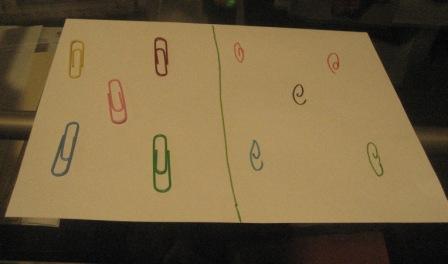
Finally, grab something they can manipulate.  It can even be snacks like goldfish.  I grabbed paper clips simply because it was sitting on my desk. Like I said, I’m not fancy.

1.  Get excited with your child as you ask them to make a number book with you.  “Let’s make a book for the numbers we like to count! What number do you want to make a book for first?”  (Choice is an incentive for most children).

2. After your child has picked a number write it on the front of a folded piece of paper.  If you really want to let them let loose, tell them to write the number a many times as they want on the front cover to “decorate” for you.

3.  Ask them to help you count “that many” objects for your book.

4.  On the left side of the book let them arrange the objects however they want, and then ask them to “record” or write it down exactly the way they arrange it “so that we will remember what it looks like” and then allow them to do that for each page with as many different creations as they come up with.  Staple their book and make sure their name is on the cover 🙂
The Sneaky Teacher

Today you are going to do something a little different than normal. You are going to pick a surface in your house that you want to clean, but one that can be cleaned with shaving cream…this post isn’t called “the sneaky teacher” for nothing….
you are going to clean, and teach at the same time. I personally would pick the bath tub, but you may have something else in mind.
Let your child help you rub shaving cream all over the bath tub and then say “ooohh, let’s use our fingers to write and draw!” Some great writing activities would be: writng your name, their name, any letters your child knows, introduce letters your child doesn’t know, numbers, shapes, and anything in between. This is a fun, child-friendly way to write, strengthen motor skills, learn and practice letter and number formation, and clean your bath tub all in one!
Shaving cream is great for cleaning surfaces such as a bath tub (google to make sure it is for your bath depending on the material) but be careful that it does not get in your child’s eyes!!! Monitor this time and clearly communicate before beginning that they need to keep their hands away from anything except the bath tub. Tell them it could hurt their eyes and mouth if they touch their face, etc.
For other tips and info. read “writing with a twist” and “the timeless teacher” writing posts 🙂
As always, have fun!

Chunks, syllables, and sounds…what’s the difference?

There are soooo many things that I will share about teaching your child to read, but I have to start with the basic pre-reading info to give you a well-rounded understanding of how reading skills are acquired.

So for now, I am going to introduce a new aspect of reading development which also has to do with hearing chunks (word parts) within words….

The more you play with words the more children will get the idea that a word is made up of sounds, the more they will be listening for those sounds.  This gives children experience putting sounds together to make a word.  So, eventually you will be able to say the sounds /c//a//t/ and they will finally hear the word “cat”.  But there are several things we have to establish first, and one of them is parts of a word.

A beginner reader needs to know that some words have chunks in them where they could hear a word (or words) inside of a word.  For example, “cupcake” has the word “cup” and “cake” in it and “bedroom” has “bed” and “room” in it.  As adults, we just label these words compound words, but to children this can open their eyes to what a word can be made up of.

A syllable on the other hand is a way for a child to count how many groups of sounds are in their name or other words.  One way you might teach your child they have syllables (or parts) in their name is by clapping while simultaneously saying the sound “jess (clap)- i (clap) – ca (clap)” and let your child hold up a finger every time you clap and then ask “How many parts are there?”

Then of course there are sounds…every spoken consonant, vowel, or blend like “sh”, “ch”, etc.

I will post more on all of this soon, but for now, here is an activity to help your child start hearing words within words:

compound pictures

Happy Thanksgiving!!!

Give thanks!!!!
I am giving thanks that I am in HAWAII!!! I can’t believe it; it is beautiful and breath-taking. My husband would be baffled to know that I am online today haha, but when you have been awake since 4 am with a 6 month old who hasn’t adjusted to the timezone change, unplanned things happen.  But I can assure you I won’t be back online to post again until Monday, when I am home from vacation 🙂

Depending on your timezone, you have probably already eaten your Thanksgiving lunch, but I am just now eating breakfast; maybe you can do some of my activity ideas after your nap 🙂

Math:
1. Count your blessings.
2. Count the place settings.
3. See how many circles and squares you can count on your dinner table. (plates, the table, napkins, etc.) Make a tally of each and figure out which has more.

Writing:
1. Let your child help make name plates
2. Make a list of all the things your child ate/tasted at lunch.

Reading:
1. Read them your list -from the writing idea (#1), pointing to the items on the list as you read aloud. This gives meaning to the print, introduces a list which is something we will talk about in a future post, and if you sound out the first sound in each word right before you read the word it can be a phonemic awareness activity which just means that it gives children awareness that letters have sounds. So read your list like this: “/t//t/ turkey”, /r//r/ rolls,” etc. When you see a letter in // it means to say the letter’s sound.

Enjoy!

The Timeless Teacher…

There is no way to know how long teachers have been using play dough or modeling clay as a means to teach their students to form letters.  It is fun, practical, and it teaches children to form letters in a hands-on, meangingful way.  IF they can form it, they can write it….once they get the motor skills down.

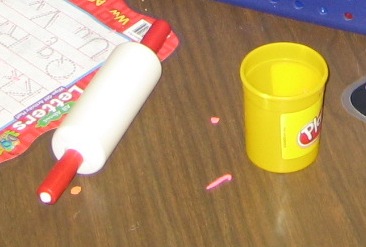
So my writing activity for today is to 1) Write the letters you want your child to practice onto cardstock with a highlighter or yellow marker.  2) Let your child trace over the letter you made (starting at the top) with a pen or other writing tool and then help them form the clay.  If it is the letter A, for example, as you write the letter you might say “I am going to make the letter ‘A’.  It is a tall letter so I am going to start at the very top and slide down the slide this way (to the left) then do it again because that was fun!  Slide down this way (to the right) and then climb across the monkey bars in between.  Your turn!”  3) Start working with the clay/play dough.  When you are forming the clay you might roll it out like a snake and begin to make the pieces of the play dough to cover the letter.  While you form the dough you might say something like, “Okay let’s make the slides, and then the monkey bars for the letter ‘A’ so we can pretend to slide down again”.

Like my recent post “Do your know your ABC’s” said “Always Be Creative;” when you are making up how to form the letters, think about what it reminds you of or ask your child what it reminds them of.

If you want to use your kitchen roller to roll out the play dough, why not?  Have a ball.

Related Posts Plugin for WordPress, Blogger...

1 68 69 70 71 72