Casey

Wife, Stay at home Mom of 3, Owner, artist and designer for Kidspired Creations

Learning to Think: “What’s More Important?”

My kids often do things that are expectedly unexpected (if that even makes sense).  If I tell my kids to do something and they have a reaction that I didn’t anticipate, it is unexpected… but since it happens every single day a bajillion times a day… really… how unexpected can it be?  Expectedly unexpected.

Expectedly unexpect this, kids:  MY reaction to above situation.  I get annoyed.  Punish.  Yell.  Throw a Mommy hissy fit if it is the umpteenth time I have told them to turn off the TV.  Put the kids in timeout.  Take away the TV for the day.  Talk talk talk talk talk about how they disobeyed.  Seriously, you’d think they’d learn.  You think, I’d learn.

Well, I had this re-epiphany the other day.  A re-epiphany is that ‘aha’ moment that has been tucked away in our heads.  Sometimes we just need a little reminder.  And here is my re-epiphany… I need to teach my kids HOW TO THINK!

Pre-Re-Epiphany:

Me:  “It’s time to get dressed…”

Yet they continued to play with toys.

Me:  “C’mon boys, let’s get dressed.”

Nothing.

Me:  “Stop playing with toys and get dressed!”

Yeah, I’m not proud of those moments when I snap.  So, I have recently started turning the conversation around by verbally thinking about and questioning the situation to give them a chance to make the correct decision about what is the important thing to do to accomplish a task.

Post-Re-Epiphany

Me:  “It’s time to get dressed.”

They continue to play with toys.

Me:  “We need to get to school on time, so which is more important right now:  playing with toys or getting dressed?

Boys:  “Getting dressed.”

Me:  “What happens if we play with toys instead of getting dressed?”

Boys: “Then we are going to be late for school…”

and my little one added: “Then Mommy will be maaaaad.”

Yup… I guess I needed this little epiphany to get myself to chill out because fussing at my kids apparently sticks in their little minds.

I have been focusing my conversations with the kids on using guiding questions to help them discern how to behave.  The things that you and I as adults do automatically in our heads do not come naturally to young kids, but we can teach them the thought process that needs to be going through their minds.  We can verbally model that for them so they start doing it as well:

Is this the right thing to do?

Which is more important?

What would happen if I didn’t listen?

This type of teaching will help your kids learn how to think things through.  If you notice, I talked about our goal:  to get to school on time.  Then I narrowed down the field of all of the possible things they could be doing right now to two things:  playing with toys (the action they are doing) and getting dressed (the action I need them to be doing.

I then ask “What is more important right now?”  The right now is important because we do not want them to think that the things that matter most to them aren’t important, but at that exact moment, which is the MOST important.  With my 3-year-old, I sometimes also have to say, “We can play with our toys after homework today when it is play time,” to remind him that his own personal goal (to play with toys) will also be fulfilled, but at a later point today.

We have used this approach for many things this week – most of them have been in the format of prioritizing which activity will best help us to reach our goal.

Teaching how to think is cross-curricular.  You already teach foreshadowing (what’s going to happen next) in reading and math (sequencing) and cause and effect in science.  This is just taking the same conversational approach and applying it to behavior.

I recommend also having these conversations during regular play, not just when you need them to do something.  Expect the unexpected.  Try to anticipate how they might do something that you will have to fuss them for and start a conversation about it before it happens…

Mommy Teacher: “If we are going to play in your room which is next to your sleeping sister’s room, is it more important to talk loudly or quietly?”

Child:  “Quietly.”

Mommy Teacher:  “Why do we need to talk quietly?”

Child:  “Because we do not want to wake Sister up.”

And if you’re like me and have a little lawyer or politician on your hands who will try to argue his decision to choose to do something besides what you need him to do, just remind him to think about what is MOST important to accomplish the end goal.
Code Word

I have taken graduate level courses in child psychology and behavior management.  I have spent countless hours in classes, seminars and meetings about how to set rules, boundaries, and expectations  and how to discipline effectively using positive reinforcements – and had a few years in the classroom using those practices that I was taught.  I have read books and manuals and blogs and magazines and read and read and read and studied about how to get my students to do what I need them to do, when I need them to do it.

And my expert, degreed self had a vision of how I would teach and discipline my own kids one day (as if MY kids would ever need it).    Here’s how my perfect mommy self would “handle” (for lack of a better word – where’s my thesaurus???) my kids.

1.  I would always explain why I needed them to do something. “The reason I need you to be quiet right now is because Mommy needs to make a phone call and I can’t hear the person on the other line when you are also talking.”

2.  I would always use positive speak (i.e. “Walk”  instead of “Don’t run.”)

3.  “Because I said so” would NEVER be a spoken from my mouth.  Instead I would always do #1.

(Ok.  You can stop laughing at me now.  We are always better parents before we are actually parents, right?)

So, then I became a real parent, and you know what I learned when my first born was a toddler?  “Because I said so” sometimes IS the reason I need them to stop what they are doing.  Maybe because they wouldn’t understand the real reason, or maybe because I just don’t feel like giving a reason (I’m not alone here!), or maybe because there isn’t any time to explain.  For example…

When my oldest son was a little over two, I took him and his baby brother to the park with some friends.  Up to this point, I believe I had stuck to my ideal vision that I stated above – pretty easy to do when they are in the baby and new-toddler phases.

I was sitting on the picnic blanket nursing the baby who was still in “blob mode”(around 2 months old) and my two-year-old was running in the open field between me and the parking lot.  At one point, he decided to chase some older kids who were closer to the parking lot.

Realizing I was a little tied up at the moment (bare breasts under the nursing cover), I decided to raise my voice (not yell… no, never yell) at my son to come play closer to me…

“James, come back!”

Haha, yeah, like that worked.  The two-year-old ran a little farther away.

“Jaaaames!  Come back over here, please!”

And to my naive astonishment, the kid didn’t even slow down.  In fact, I believe he sped up!

Then, it hit me.  I had always been close enough to him to be able to explain to him WHY he shouldn’t be doing something.  This insta-command thing was new.  He had never heard it before.  So just as he was nearing the parking lot, I yelled,

“JAMES!  YOU NEED TO GET OVER HERE RIGHT NOW BECAUSE YOU ARE ABOUT TO RUN INTO A PARKING LOT AND THERE ARE CARS AND YOU COULD GET HIT BY A CAR BECAUSE YOU ARE TOO SHORT AND THEY WON’T BE ABLE TO SEE YOU AND THAT WOULD HURT A LOT!”

Or something to that effect.

That moment right there, the first time my son completely ignored me.  It wasn’t until I gave him that explanation of WHY he shouldn’t do something, completely changed my ideal vision of parenting.  Why did he do that?  Because up until that day I had explained every.little.thing to him… and don’t get me wrong!  That’s how they learn best how to not just DO, but understand right versus wrong.

But in an emergency… when they truly truly need to stop what they are doing.  They need to STOP.  NOW.  There is no time for an explanation.  They need to understand that you mean business.

That’s when I invented the “code word.”  I needed a shortcut to get my child to listen without question.

FREEZE.

We went home and practiced it.  FREEZE.  When Mommy says that word, it does not matter what you are doing, what you WANT to be doing or what you were ABOUT to do; you are going to stop, put your hands on your head, and turn to look at me.

Now, the “put your hands on your head” part may seem a bit extreme, but trust me, when they are playing with a toy, the only way to get their undivided attention is to make sure their hands are empty.

I recently noticed my 3-year-old doing the same thing as my older son had done years before.  This week, I brought back our old friend, FREEZE.

The kids have a great time playing our FREEZE game where they get to cut up and act crazy, then Mommy yells “FREEZE” and they immediately stop with their hands on their head.  They also like playing Mommy’s role and telling me when to FREEZE.

With some short reminders in the car when we are about to go into the store or play at the park, the kids remember to respond immediately when I yell the code word.  It’s also a great way to get both of their attention when I need them to switch activities.  It gives me time to explain how we are going to transition into the next activity.

Do you have a code word?  What do you use?  Comment below to share!!!


Grandparents Day 2013

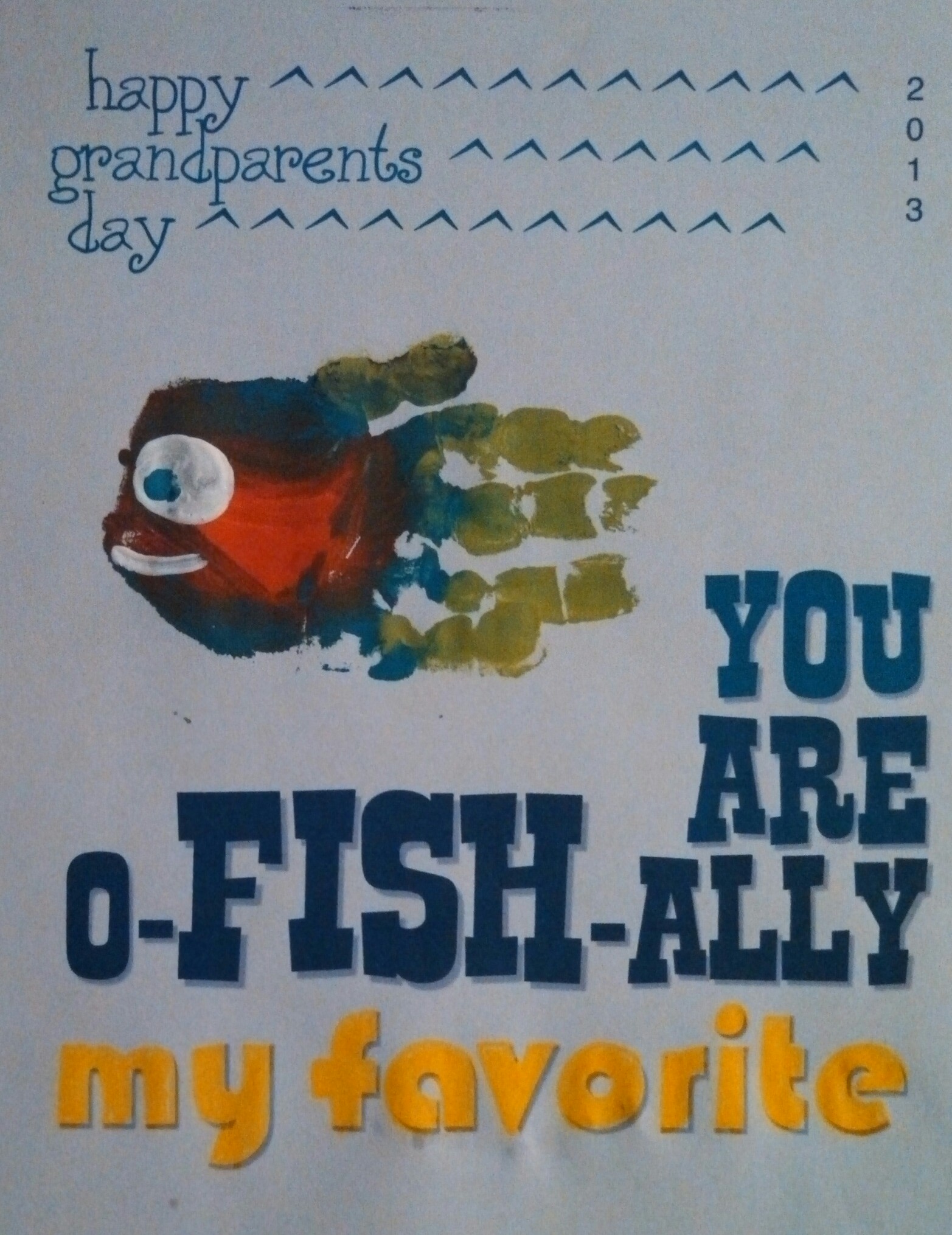
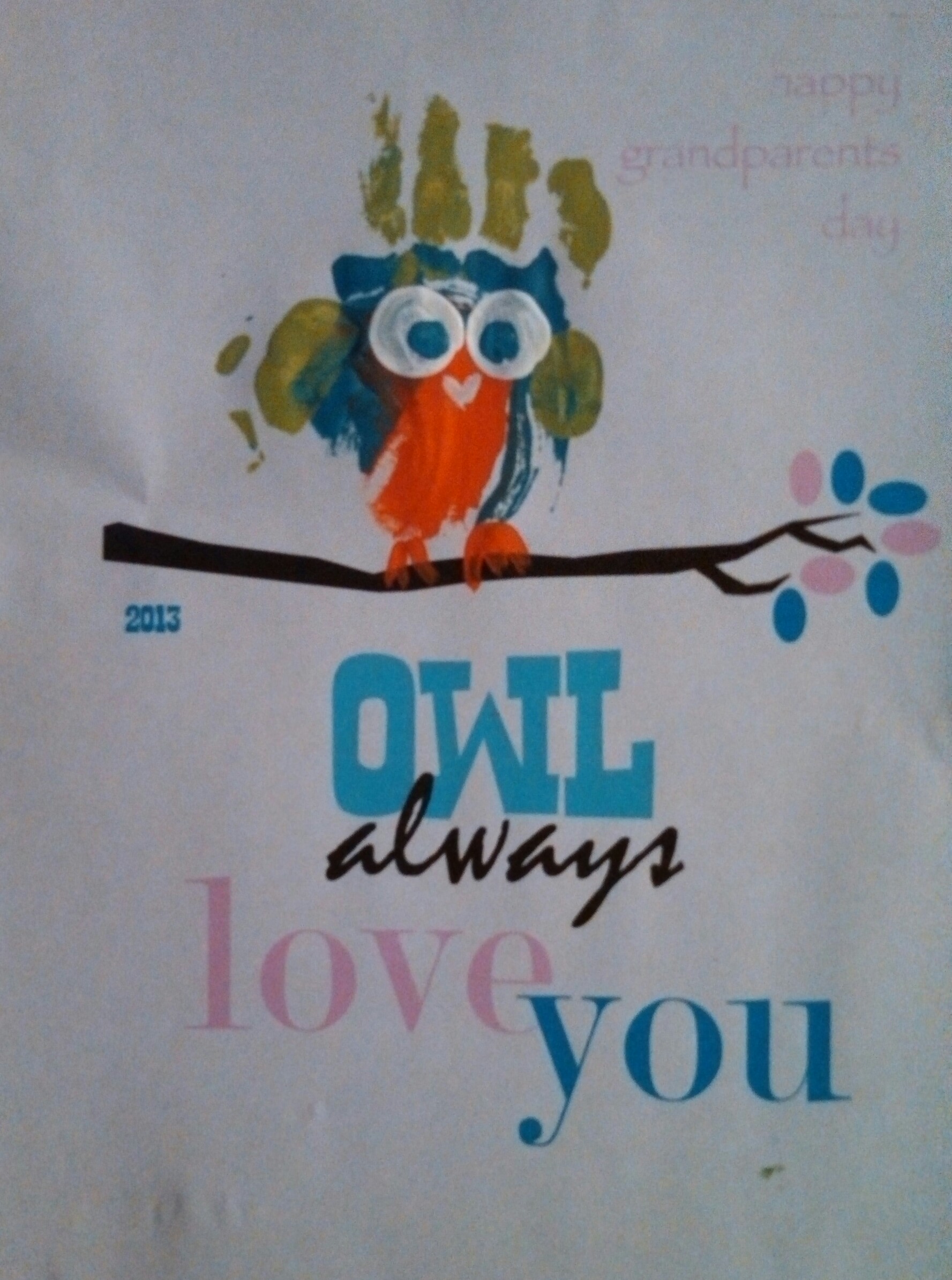
HEAD’S UP, MOMMY TEACHERS!  This Sunday is Grandparents Day!  My kids love their grandparents so much and wanted to make them a special gift for their big day!

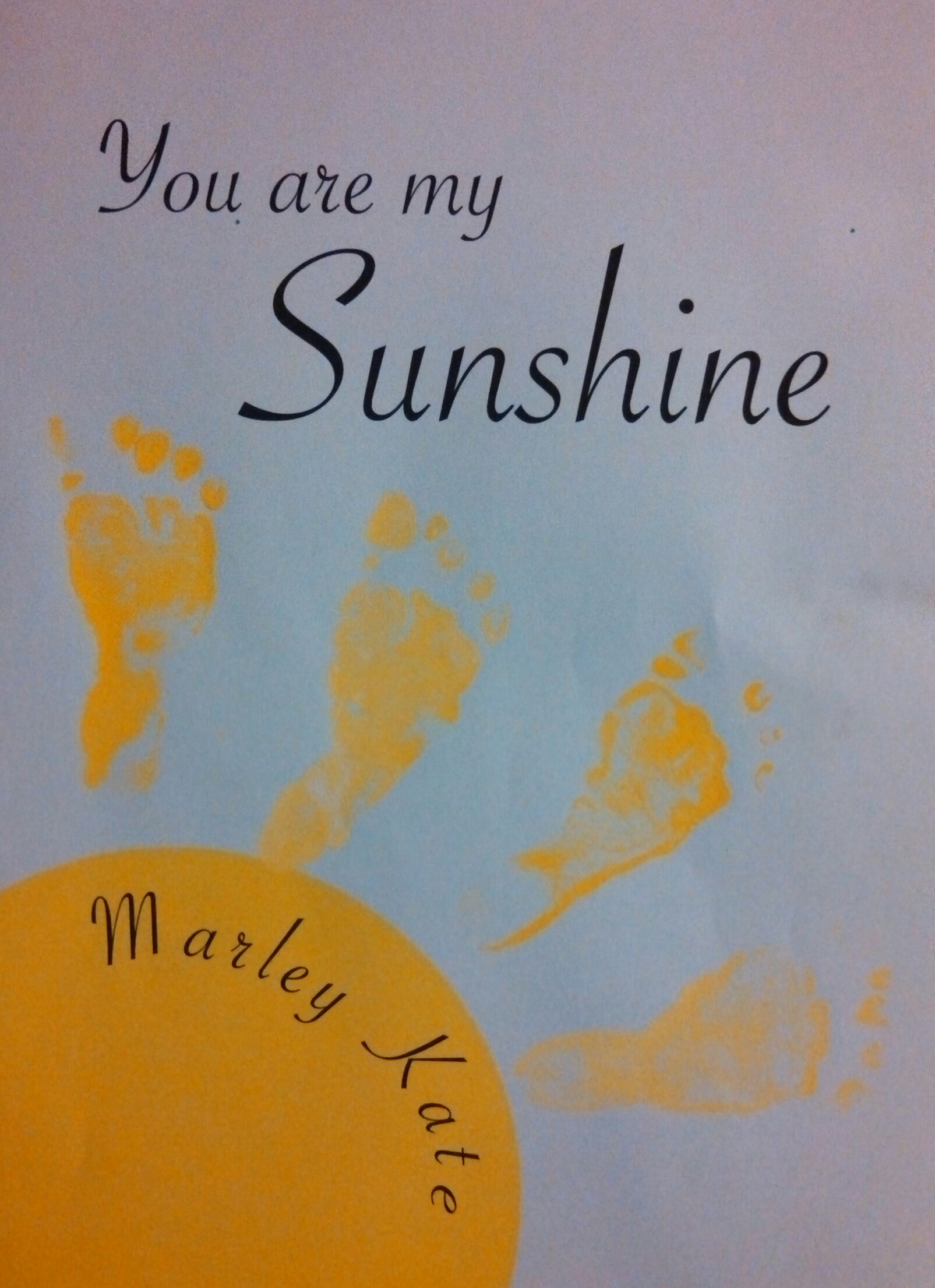
My 4-month old niece, Marley Kate, recently sent me a cute letter and it inspired our Grandparents Day gifts.

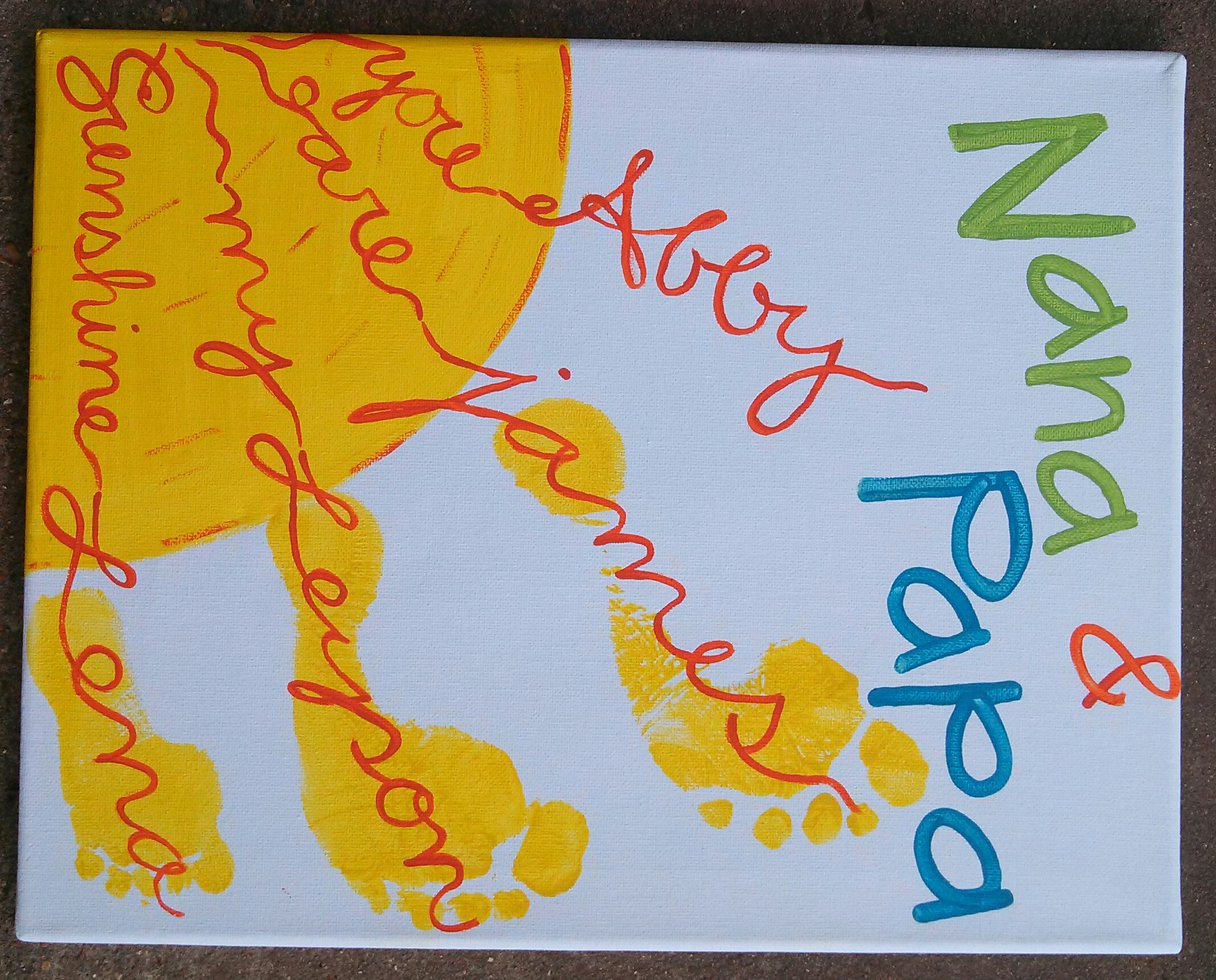
IMG_20130904_112815_535-1 Since our printer is broken, I decided to hand paint ours, and leave a spot open for my niece, Abby, to stamp her foot, too.  This one below is on its way to Oklahoma right now.

IMG_20130903_141810_362-1 Then I thought it would be a great idea to make a few hand print art templates for you to purchase and download so your children can make beautiful art for their grandparents too!

In addition to a “You Are My Sunshine” template for your baby/toddler’s footprints, I have also made a “You Are o-FISH-ally My Favorite” template for a sideways hand print and an “Owl Always Love You” template for a palm hand print and thumbprints for wings.

IMG_20130904_111206_280-1 IMG_20130904_111215_378-1 These templates are available to download this week for just $1 for all 3!  Enjoy!

[purchase_link id=”4008″ style=”button” color=”blue” text=”Purchase”]

Happy Grandparents Day to all of you Grammy and Grampy Teachers out there!!!  Thank you for all that you do!  Your grandchildren love and appreciate you!


Tying Shoes

After much begging and pleading from my 6 year old, Mommy finally gave in… I bought him a pair of shoes with ::gasp:: laces instead of velcro!  I told him he would not be allowed to wear them until he learned how to tie his shoes – and without tears.

I tried to teach him how to tie his shoes when he was in Kindergarten and after much frustration on both ends, we gave up pretty quickly.  That’s when I decided he would be wearing velcro until he hit high school.  The bunny ears just were not working with his little uncoordinated fingers.

I recently ran across this video and shared it on our Facebook page.  Amazing.  Forget bunny ears, this is so much easier!  James watched the video with me and that’s when I first heard the dreaded, “I want shoes with laceeeeesssssss.”

I thought that he had possibly forgotten about that video when we went shoe shopping for new school shoes, but boy was I wrong!  We immediately saw two identical shoes, one with velcro and one with laces and he was dead set on the one with laces.  Great.

When we got home with our new shoes (with laces) I pulled up the above video.  We watched it once, I tried it once, and then it was his turn.  I kid you KNOT (get it?) James learned how to tie his shoes in 15 minutes!  He practiced a few times and then made his own tutorial to show you and your kids!  Enjoy!

UPDATE 8/30 – The video is not uploading properly, so to view it, please click here!

For your older child, if he or she is interested in learning new knots, check out this website, shared by one of our fellow Mommy Teachers on our Facebook page.

Clap Your Hands to the Beat

My sister and I each grew up playing instruments – our choice, not our parents –  because we had been exposed to music.  I made the decision at 5 years old to play the violin after seeing an orchestra perform on TV.  And what do you know?  My new school that next year had a violin teacher!   Watching that first chairperson on the TV screen sparked a passion in me that lasted throughout all of my school days.

Art, music, dance, and theater education are what mold our creativity, interests and passions, yet they are quickly the first things that are cut from the classroom due to budget cuts or lack of time for core subjects to be taught in a school day.  The exposure to the arts that we once had in schools is quickly diminishing so it’s up to us Mommy Teachers to introduce these “extracurricular” activities at home.

If you have a talent or passion for the arts, share what you love with your child.  If you don’t have a background in any of these areas, you have the world of knowledge at your fingertips!  Google and YouTube can literally teach you the basics of anything you want to know!

Will my children share my same interests?  Perhaps, perhaps not, but that exposure will help guide their interests and interests can quickly turn to passion and yes, I want my children to be passionate about something that they love.

My children have been exposed the few instruments that I dabble in and, to my dismay, this did not make my oldest child interested in music in the least bit – so don’t think you need to be a master musician to get your kids to like music.  In fact, James (age 6) would always say, “Will you please stop playing the violin??? It’s too loud!  It’s hurting my ears!”  I honestly think he just doesn’t like anything making more noise than he does ;-), but, I digress…

What my son DOES like, is MATH!  And music THEORY is basically math!  Half notes, quarter notes, eighth notes… all math!  And then there are (most commonly and for the sake of teaching young kids) 4 beats to each measure, that’s 1 whole note, or 2 half notes, or 4 quarter notes, or 8 eighth notes… or you have to figure out a combination of all of them that equals 4!  WHOA!  My math nerd was instantly hooked to MUSIC after our first lesson about clapping out the music!

IMG_20130724_154359_657 I started off by teaching the different notes, starting with the QUARTER NOTE.

A quarter note is 1 count. So we count 1…2…3…4… and clap on each count… clap…clap…clap…clap.

The half note is 2 counts 1…*…3…*…  (clap on the numbers in bold, and hold the clap for the *.  When counting, still say numbers 1…2…3…4…).

The whole note is 4 whole counts. 1…*…*…*… (only clap on the 1st count in the measure).

The eighth note is half of 1 count.  For this note, we verbally and an “and” between our numbers when we count.  1 and 2 and 3 and 4 and.  clap clap clap clap clap clap clap clap.

If you want to get real fancy, you can also introduce the sixteenth note which is a quarter of a quarter note. 1 ee and uh 2 ee and uh 3 ee and uh 4 ee and uh (there should be 16 claps in there).  James:  “Whoa that’s way too fast.”  So we just stopped at the eighth note.

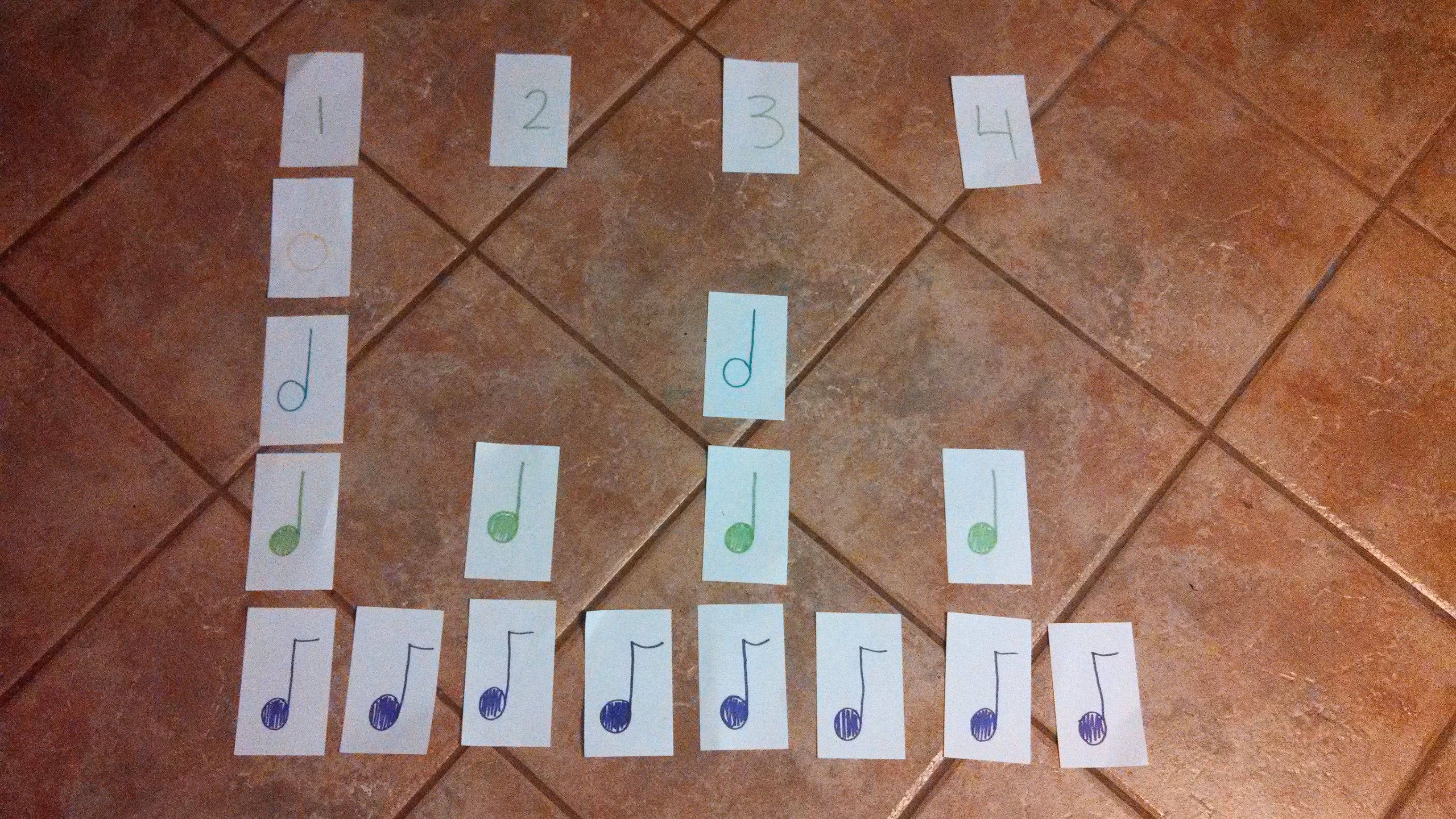
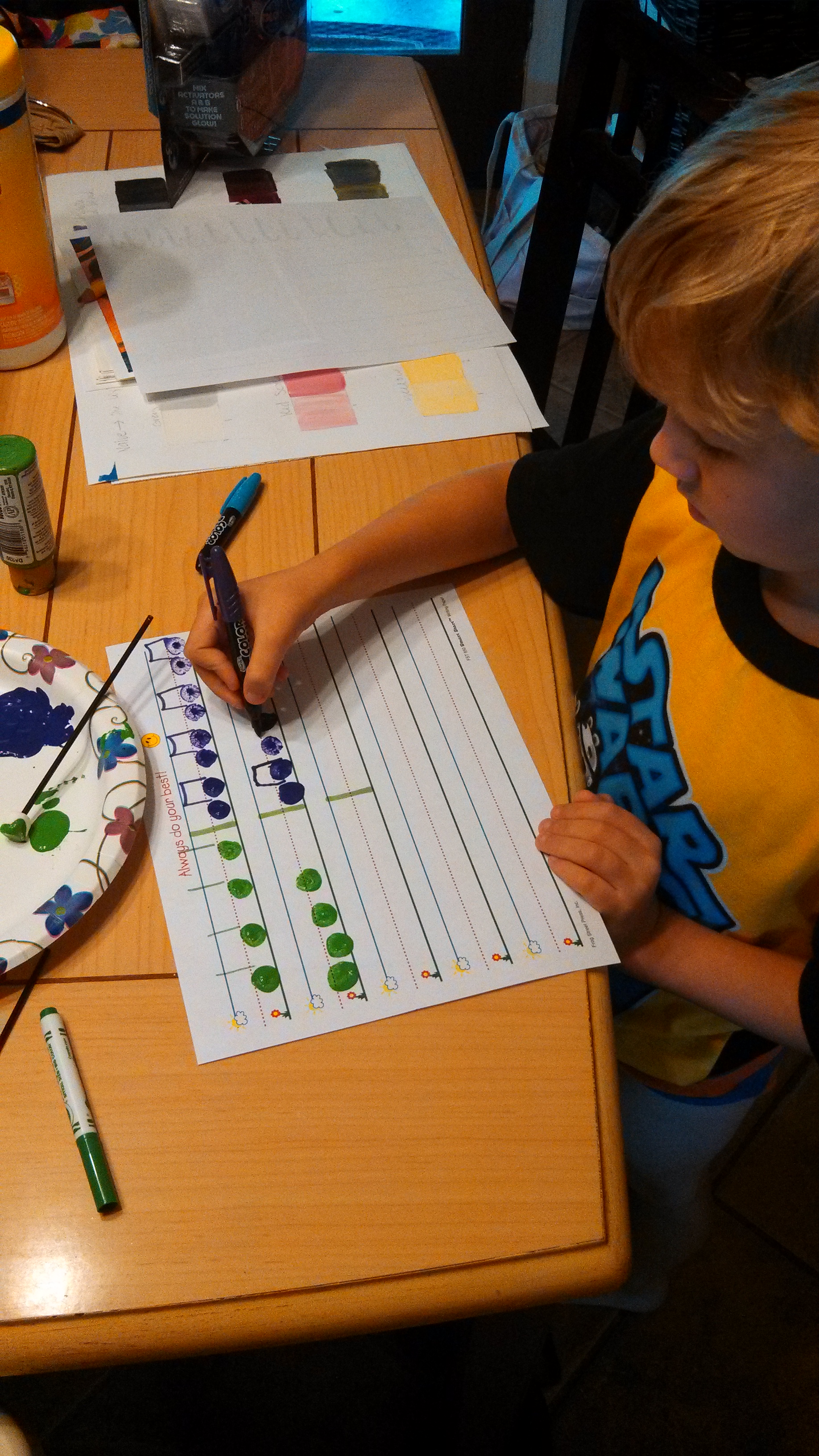
As I introduced the notes, we did a little art projects to put our notes into measures so he could see how 4 counts fit inside each measure.

Bar Lines & Measures Now, I don’t just have blank music sheets lying around my house, so I used lined writing paper that the kids use in Pre-K and Kindergarten.  3 lines, 5 lines… that wasn’t my focus for this lesson.

Materials:

  • 4 small marshmallows
  • markers
  • paint (4 different colors)
  • lined/handwriting paper
  • 4 stirring straws

IMG_20130724_153029_042 1.  Choose 4 colors of paint and decide which color will represent which note (the differences in color help the kids remember the notes better)

2.  Stick each marshmallow on the end of each stirring straw.

3.  Draw “measure lines” on your paper.  I put them down the middle so there was enough space for all of the eighth notes in one measure.

4.  Start with the quarter note and dip the marshmallow into the paint.  Put 4 quarter notes into one measure.  I did the top line and had my child copy me on the line beneath.  In the next measure, choose a different color for eighth notes.  Dip a new marshmallow into the new color and put 8 eighth notes into the measure.  Have your child copy you on the lines beneath.

5.  Clap out your new song.

1…2…3…4…
1 and 2 and 3 and 4 and
1…2…3…4…
1 and 2 and 3 and 4 and

6.  For the half and whole notes, choose 2 different colors of paint.  This time, instead of dipping the whole marshmallow into the paint, just roll the edges of the marshmallow in the paint so you get the hallowed center for the note.

7.  In a new measure, put 2 half notes into one measure, spaced evenly.  In the next measure, put 1 whole note in the measure.  Have your child copy you.

8.  Clap out your new measures.

1…*…3…*…
1…*…*…*…
1…*…3…*…
1…*…*…*…

9. Then clap out your whole song:

1…      2…     3…      4…
1 and 2 and 3 and 4 and
1…     2…      3…      4…
1 and 2 and 3 and 4 and
1…       *…     3…      *…
1…       *…     *…       *…
1…       *…     3…       *…
1…       *…     *…        *…”

Here is a video of my 6 year old clapping the beat out on his own for the first time.  He was so proud that I didn’t have to help him!

Yay!  You and your child have just written your first song together!  Feel free to add words to your music and more!

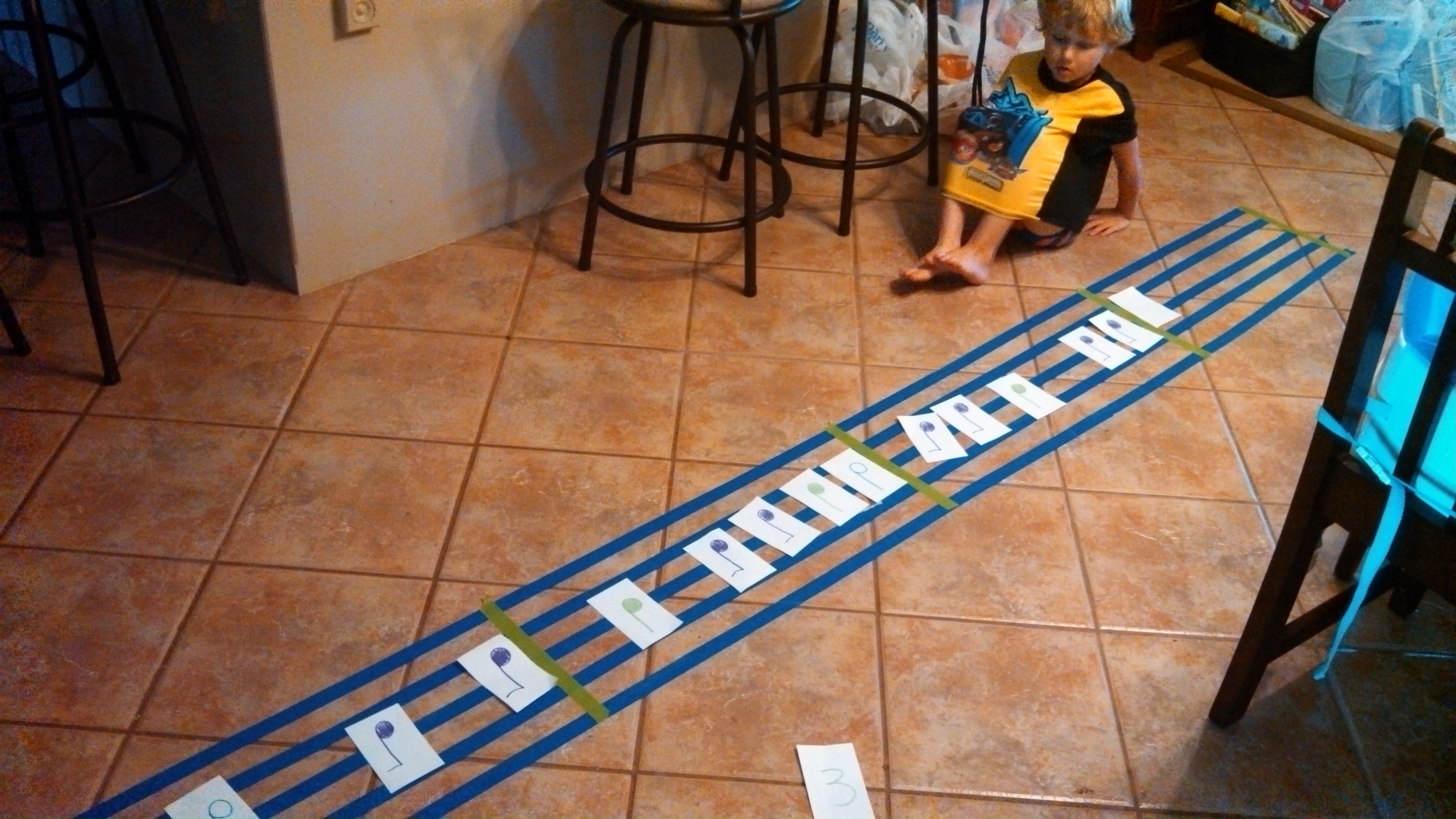
For our next activity, I created a giant musical staff (this time with 5 lines) on our floor using painters tape!  We used our index cards with our notes from the picture above to figure out how we can fit 4 beats into each measure using a combination of all the notes we learned about!  I used a different color tape for the measure lines because it was easier to see.

IMG_20130724_155833_636

OTHER ACTIVITIES AND VARIATIONS OF ACTIVITIES:

  • Clap out the notes in familiar simple songs such as “Twinkle, Twinkle Little Star” or “Mary had a Little Lamb.”  Both of these songs uses quarter notes and half notes.  See if you and your child can recreate these songs on your big musical staff!
  • The song “BINGO” is a great way to practice clapping notes.  “::clap:: I  – N – G – O, ::clap:: I  – N – G – O, ::clap:: I  – N – G – O, and that’s how we spell Bingo.”
  • Use other instruments instead of clapping:  kazoo, pots and pans as drums, shakers, recorders, etc.
  • What other parts of your body can you use to “sing” the music?  Try stomping, jumping, squatting, conducting with your index finger, etc.

The possibilities are endless!  Music is so much fun!

Related Posts Plugin for WordPress, Blogger...

1 4 5 6 7 8 10